
This original cover image was scanned from my private collection
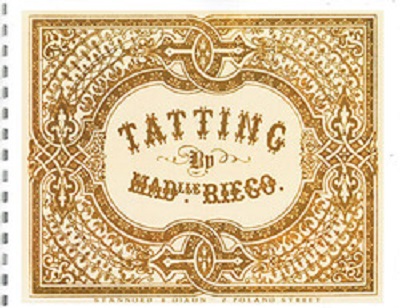
This reproduction image was scanned from my private collection
TABLE OF CONTENTS
- Preface
- Instruction in Tatting
- Edging, No. 1
- Collar: Oriel Pattern
- Insertion
- Edging, No. 2
- Collar: Maltese Pattern
- Cuffs to Correspond
- Fruit D'oyley
- D'Oyley in Colours(in third edition)
- Bunch of Grapes
- Applique Waistcoat
- Mourning Collar
Title: Tatting
Author/Designer: Madlle Riego de la Branchardiere
Format/Publication Date: TPB:1850,2011reprint
Publisher: (1850)Simkin, Marshall, and Co., London, England,
(2011)Iva Rose Vintage Reproductions, New Bedford, MA
Page Count: 36
Book Dimensions(ht. x w.): (1850)4 3/4" x 6"; (2011)8 1/2" x 11"
ISBN: None
SUMMARY- On May 1st, 1851, the World Fair Exhibition opened in London, as a celebration of modern industrial technology and design. It was intended to "one up" the French Exposition of 1844. Six million people attended between the opening day, and its closing on October 11 of the same year, walking among all the modern marvels on display in a building that was a marvel on its own - made entirely of steel and glass, which allowed natural lighting throughout, and was dubbed the Crystal Palace.
Textiles were included, and a working demonstration that took the watchers from cotton boll to cloth was given. Among all the many marvels presented was a display of crochet and tatting by Mademoiselle Eléanor Riego de la Branchardiere - popularly known as Mdlle. Riego - who was only 23 years old at the time(she was born in 1828 according to the 1851 census, of an Irish mother and French father). She published her first book, "Knitting, Crochet and Netting" in 1846 at the age of 18! She won the prize metal in 1851 "for the skill displayed in the imitation of old Spanish and other costly laces", and continued to win medals for her exceptional work, including a child's dress made entirely of crochet. She was very accomplished in many needlecrafts, as a designer and as an author able to convey her patterns for others to follow. While she is accredited with the picot join, that technique done with a shuttle came about somewhat later, published by Mrs. Cornelia Mee. Mdlle Riego did join her picots, but with a netting shuttle(very thin) and not with the tatting shuttle, still making a durable fabric as she went rather than with the tedious sewing that put disparate rings together before. That was the birth of modern tatting, and this booklet was the first to show all the exciting possiblities of this needle craft. Because of this, it is considered the very first book of modern tatting.
The cover shown here at the top left is of the well done reproduction published by Iva Rose Vintage Reproductions that can be had at a far more reasonable cost than an original(Iva Rose Vintage Reproductions offers quite a few antique needlework books - I highly recommend her catalog). The cover below the Table of Contents is of an original 3rd edition! There were 15,000 printed of the third edition - clearly they had not anticipated how high the demand would be. I can imagine women going home from the exhibition, on fire with excitement to recreate for themselves one of the beautiful examples they had just seen, and trying desperately to remember how their maiden aunt, who's apron pockets had always been full of bits of thread made into rings and scallops for decorating the latest baby's clothes, had done them.
There aren't that many patterns offered, compared to later tatting craft books, but what you get are quite lovely, and I had fun reading her preface and instructions to compare how we tat today. Her books are more for historical value now - for scholars of the craft - than for people who want practical patterns to use in their homes and as gifts. I was able to compare a first edition with the third edition, as later printings of books were often excerpted. There is one thing added to later editions of the book - two lines for making the Fruit D'Oyley in coloured bands rather than the traditional ecrue or white. I've marked the added text in italics in the table of contents.
I've seen a fifth edition of this book published in 1862 - so it was reprinted at least five times.