|
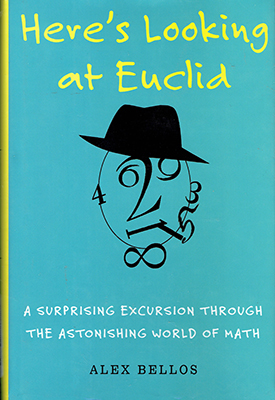
This image was scanned from the Dianna May Martin personal library collection
TABLE OF CONTENTS
- Preface
- Chapter Zero- A head for numbers(In which the author tries to find out where numbers come from, since they haven't been around that long. He meets a man who has lived in the jungle and a chmpanzee who has always lived in the city.)
- Chapter One- The counter culture(In which the author learns about the tyranny of ten, and the revolutionaries plotting its downfall. He goes to an after-school club in Tokyo where the puils learn to calculate by thinking about beads.)
- Chapter Two- Behold!(In which the author almost changes his name because the disciple of a Greek cult leader says he must. Instead, he follows the instructions of another Greek thinker, dusts off his compass and folds two business cards into a tetrahedron.)
- Chapter Three- Something about nothing(In which the author travels to India for an audience with a Hindu seer. He discovers some very slow methods of arithmetic and some very fast ones.)
- Chapter Four- Life of pi(In which the author is in Germany to witness the world's fastest mental multiplication. It is a roundabout way to begin telling the story of circles, a transcendental tale that leads him to a New York sofa.)
- Chapter Five- The x-factor(In which the author explains why numbers are good but letters are better. He visits a man in the English countryside who collects slide rules and hears the tragic tale of their demise. Includes an exposition of logarithms and how to make a superegg.)
- Chapter Six- Playtime(In which the author is ona mathematical puzzle quest. he investigates the legacy of two Chinese men - one was a dim-witted recluse and the other fell off the earth - and then flies to Oklahoma to meet a magician.)
- Chapter Seven- Secrets of succession(In which the author is first confronted with the infinite. He encounters an unstoppable snail and a devilish family of numbers.)
- Chapter Eight- Gold finger(In which the author meets a Londoner with a claw who claims to have discovered the secret of beautiful teeth.)
- Chapter Nine- Chance is a fine thing(In which the author remembers the dukes of "hasard" and goes gambling in Reno. He takes a walk through randomness and ends up in an office block in Newport Beach - where, if he looked across the ocean, he might be able to spot a lottery winner on a desert island in the South Pacific.)
- Chapter Ten- Situation normal(In which the author's farinaceous overindulgence is an attempt to savor the birth of statistics.)
- Chapter Eleven- The end of the line(In which the author terminates his journey with potato chips and crochet. He's looking at Euclid, again, and then at a hotel with an infinite number of rooms that cannot cope with a sudden influx of guests.)
- Bibliography
- Acknowledgments
- Permissions and Credits
- Index
- About the Author
|
Title: Here's Looking at Euclid: A Surprising Excursion Through the Astonishing World of Math
Author/Designer: Alex Bellos
Format/Publication Date: HC:2010
Publisher:
Language: English
Page Count: 320
Book Dimensions(ht. x w.): 9 1/4" x 6 1/4"
ISBN: 9781416588252
SUMMARY- I had to look up the word "farinaceous" and got annoyed because he could have simply used the word "starchy" and it would have been more amusing. If you have to explain the joke it isn't funny any more. He reminds me of a SF writer friend of mine whose chief joy is using words in context that if you look them up you still don't know what they meant. Bill's face lights up with joy when I point this out to him - someone finally noticed what he was doing and called him on it. That hasn't stopped him from continuing the practice. I still read his books. There are times when such words are quite necessary, as the more common words do not quite fit the essence of the author's intent. Those words I do not mind looking up, as they illuminate the heart of the sentence in which they were used. Feh on your "farinaceous," sir. I suspect you and Bill are cut from the same cloth.
That said, I bought this book for two reasons(okay, actually three, now that I think about it). Reason One- the title is hilarious. My husband insists that punning is the lowest form of humor. I consider it one of the highest. Using Euclid in a sentence to get a double meaning is the height of clever. You're forgiven for "farinaceous." Reason Two- I am fascinated by tangrams and this book came up in a search for them. Yes, there's a bit about tangrams in Chapter Six, and yes, it's interesting to read. His examples reflect the reason we are so fascinated with this puzzle perfectly. Reason Three- I was a math geek when I was in high school. I actually got beat up by a gang of math haters because I turned in a worksheet with all the word problems for an early chapter of our book solved instead of just the three that got assigned, and the teacher said something to me in class about it. I think their concern was that they would all be expected to do this from now on, and they wanted to express their deep anxiety over this potential. I thought the word problems at the very end of the chapters were put there for fun. It was not the first nor the last time I was beaten by angry fellow students for misunderstanding what fun was. No, I wasn't an inner city kid. I grew up on a farm. I was beaten by fellow agricultural experts who felt strongly I was no better than I should be. Yes, it still puzzles me too.
So I bought the book for superficial reasons, and read the chapter that had the bit I used as justification for my obvious superficiality(though I still grin every time my eyes catch the title, so Reason One - still worth it), then I ended up spending the rest of the week reading the rest of it, rereading Chapter Six because I'd skimmed a couple sections the first go-round. I haven't been this hooked on a geek book since James Carse's "Finite and Infinite Games." And this book is going on the shelf right next to my copy of it. By god, Alex Bledsoe can write. I don't think you have to be a geek to enjoy this book(though I'm sure it helps). He expresses himself and the people he met as he globe-trotted to gather all this amazing information brilliantly, and his abuse of Euclid isn't the only funny bit. I was completely absorbed and smiling throughout. It's like he wrote this for me. If you have any intellectual curiosity and enjoy an occasional Sudoku, you'd be doing yourself a big favor hunting down a copy of this book. I am confident it will make you smile too. It's fun to be educated in an entertaining way, and Alex Bledsoe is a genius at it. The number of rabbit holes that open up as you progress through the book will keep your brain exercised for years. I think you'll get more out of it with repeated readings. That is the highest praise I know how to give any book.
|