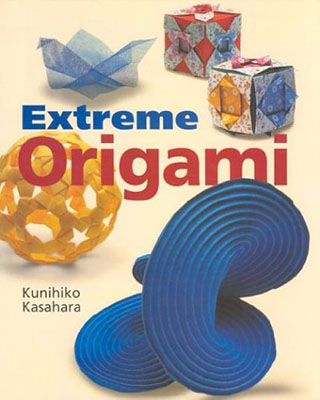
This image was scanned from my private collection
TABLE OF CONTENTS
- Introduction: The New Dimensions of Origami
- Origami Symbols
- Chapter 1: Bent Folds and Curved Surfaces
- Before the Big Bang(Thoki Yenn)-
A Picture Story
Rule 1: Using Tools
Folding Instructions
Variations - Pandanus Star
Folding Instructions
Rules 2 and 3: Materials and Techniques - Greek Soccer Ball
Folding Instructions
The Soccer Ball: A Dodecahedron
The Regular Polyhedrons - Froebel Star
- Knot Techniques
Sphere 94(Heinz Strobl)
- Before the Big Bang(Thoki Yenn)-
- Chapter 2: Imagiro and Origami: The New World
- Broken and Incomplete Folds(Paul Jackson)
Flying Dove(Syouichi Yageta) - Cutting
Folding = Cutting?
Masterpiece with Cuts
Cutting as a stage of Development
Three Dragonflies and Their Evolution - Breaking Symmetry
Cat Family
Mouse Family - Experimenting with Shape
Which Shape Do You See?
Shape Association
Painting and Gluing
Playing with Basic Forms - Using Transparency
Cat's Face(Francesco Miglionico)
Small Box ((Tato)Mitsue Fushimi)
Snowflake(Kunio Suzuki)
The Beauty of Hidden Patterns(Prof. Kunio Suzuki) - The Tamatebako: A Gift Box and Its Story
Urashima-Taro and the Tamatebako
The Origami Tamatebako
Form and Function
Folding Instructions - The Poetry of Fold Lines of a Great Imagiro(Paulo Taborda Barreto)
- Broken and Incomplete Folds(Paul Jackson)
- Chapter 3: Pinwheels and Modular Origami
- The Cube: The Fundamental Polyhedron
- Tamatebako and Pinwheel- Cube Modules
- The Pinwheel and Its Best Friends-
Pinwheel
Pajarita (Paper Bird)
Variations on the Pinwheel - Froebel's Basic Forms as Cube Modules
- The Wheel of Ideas Spins Further
- New Pinwheel Snowflakes
- Type I and II Pinwheel- Cube Modules
- Type III Super Pinwheel- Cube Modules
Panorama Box
Pajarita Cube
Crane Cubes
- INDEX